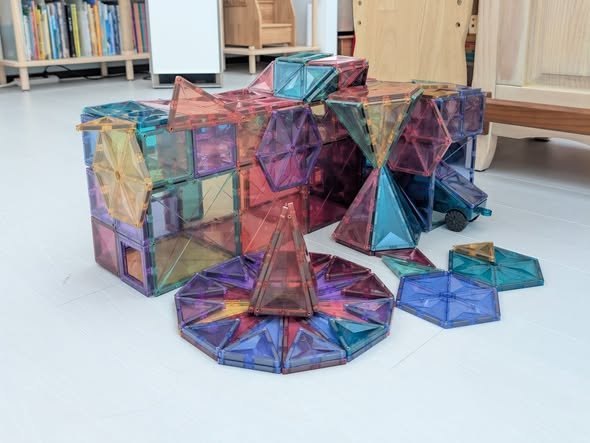
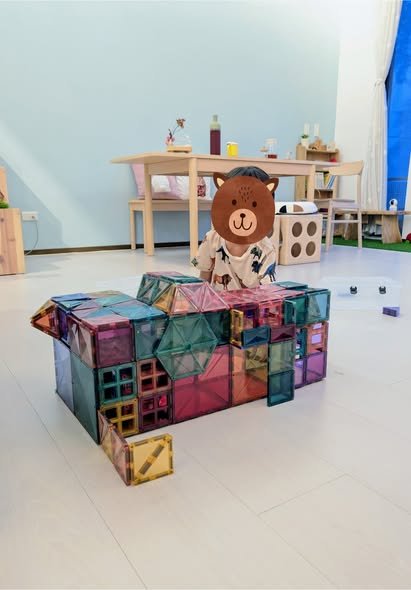
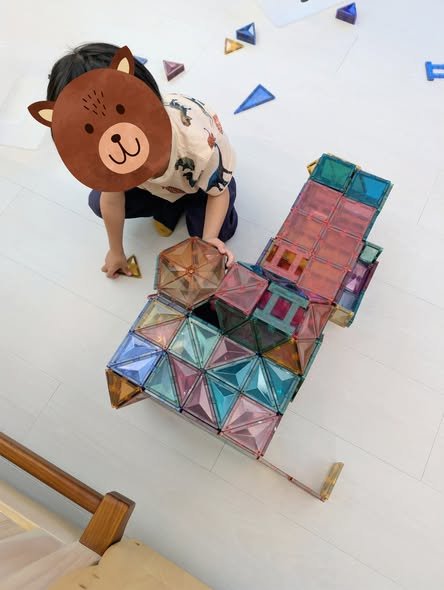
Our last little visitor was a lively six-year-old boy. Each time he comes, he picks up one toy after another, then quickly moves on to the next. From a child's point of view it makes complete sense— he already knows he has only an hour to explore, so he's really quite purposeful about finding the *playmate* worth spending his time on.
He finally settled on the magnetic tiles—CONNETIX— and, with his abundant creativity, his fine eye, and his nimble mind, gave Alice and me a rare little class in creative thinking 🙂
1 / 8
Our set has 212 pieces in all. A scale like that lets a child be bold, and pour out all the possibility inside them. For children who love blocks—magnetic ones especially— just keep them quiet company, and almost every one will play their way into flow.
2 / 8
As the tiles came out of the box one by one, the lively, restless boy dropped, all at once, into something quiet, steady and absorbed. I could barely tell when he began observing, or imagining— he just moved straight into testing, and started to build, as though the full blueprint and the whole view of it already stood in his mind, and he only needed to raise, clearly, what was already there. He was fast, and moved with a clear direction.
3 / 8
His design wasn't only practical— it considered *beauty*, too, and that was the part that took our breath ✨ (a pity we couldn't show the interior)
Alice and I sat down beside him, half admiring, half exclaiming quietly inside, full of sincere respect for the character, the ability, the creativity and the follow-through he showed all through his play.
4 / 8
This kind of playing has always been the most beguiling thing about open-ended play ✨ No manual, no standard answer, no "limits." The same set of toys—a different child, a different mood, a different day— can grow into something completely different.
Open-ended play reflects, faithfully, a child's character, their frame of mind, their inner state— and the rich world they see with the eye of the heart, the one we can't see from outside.
5 / 8
An open-ended toy won't tell a child how to play, but it becomes their finest companion— keeping them company as they freely think, freely make, freely explore, freely play. Like a good friend who understands them, it quietly stays beside them as they realise what they want to do, answering the imagination, the drive, the creativity deep within. And in exploring the material as they create, it's quietly switching on a child's own capacity to learn 😉
6 / 8
Open-ended play is thought to nurture "creativity," "imagination," and a key ability for life—"problem-solving." A child, with no prompt at all, naming the problem themselves, finding a way themselves, correcting themselves, and then finishing—themselves 😮👏 It's a perfect embodiment of the freedom and the power open-ended play hopes to give a child. This is the standard course a bout of "learning" runs through— and the very look of "growth" as it happens 🌱🌿🌳
7 / 8
Thank you to this little boy for the demonstration 🤩 and to the mother who came along with him, for the chance to see his wonderful inner world— and that happy, contented smile 😊